⚡ Quick Take
After the last two posts went out — the one on Meituan's CatPaw, the one on Alibaba's QoderWork — my inbox filled up fast. But one message stuck. The gist: these tools are free, sure, but they all have ceilings. CatPaw caps you at 500 calls. QoderWork hands you 2,000 credits and claws them back after 30 days. Is there any way to hammer GLM-5.2's API without a quota?
My first reaction: come on. Frontier-model inference costs real compute. Nobody just hands that out without a meter.
Then I went looking. Turns out, somebody does.
The company running this giveaway is not Chinese. It is NVIDIA — the GPU company, the most valuable chip firm on the planet. Its developer platform,
build.nvidia.com, is hosting a free GLM-5.2 endpoint: OpenAI-compatible, drops straight into Claude Code. Five minutes to register, no card on file.My take: of the three "free GLM-5.2" channels, this is the one worth your time. Meituan sits at the product layer. Alibaba sits at the product layer. NVIDIA skips straight down to infrastructure. Each layer burrows deeper than the last.
📰 Where the Free Key Lives: 77 Models on build.nvidia.com
NVIDIA runs a developer platform called build.nvidia.com. It hosts 141 AI models, and 77 of them expose a free API endpoint. Read that back: 77 free models. DeepSeek-V4-Pro is in there. So are Kimi-K2.6, MiniMax-M2.7, and Qwen3.5.
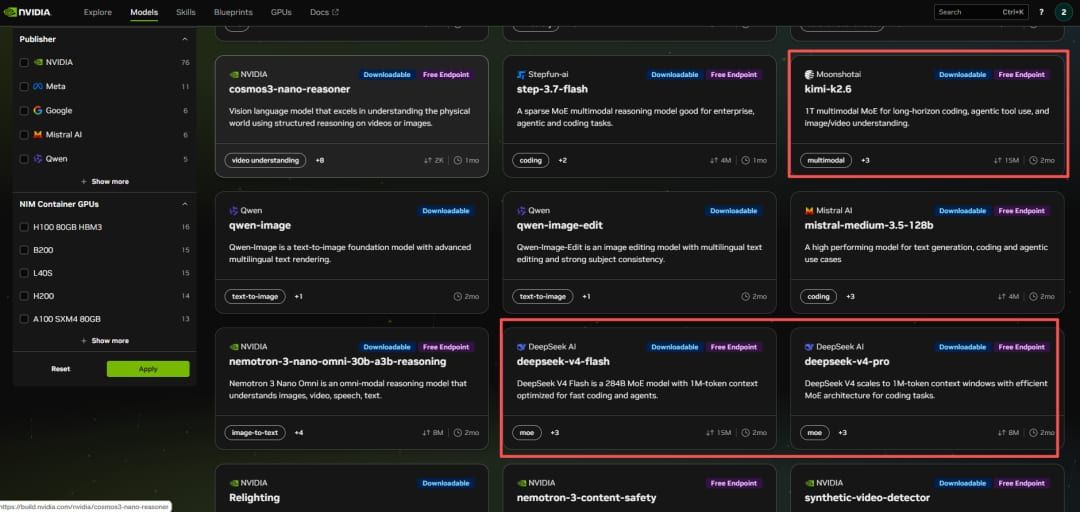
GLM-5.2 is in there too. The tags read Free Endpoint and Downloadable. The provider is Z.ai (Zhipu). It sits at the top of the freshest-models list, and one day after launch it had already cleared 2 million downloads.
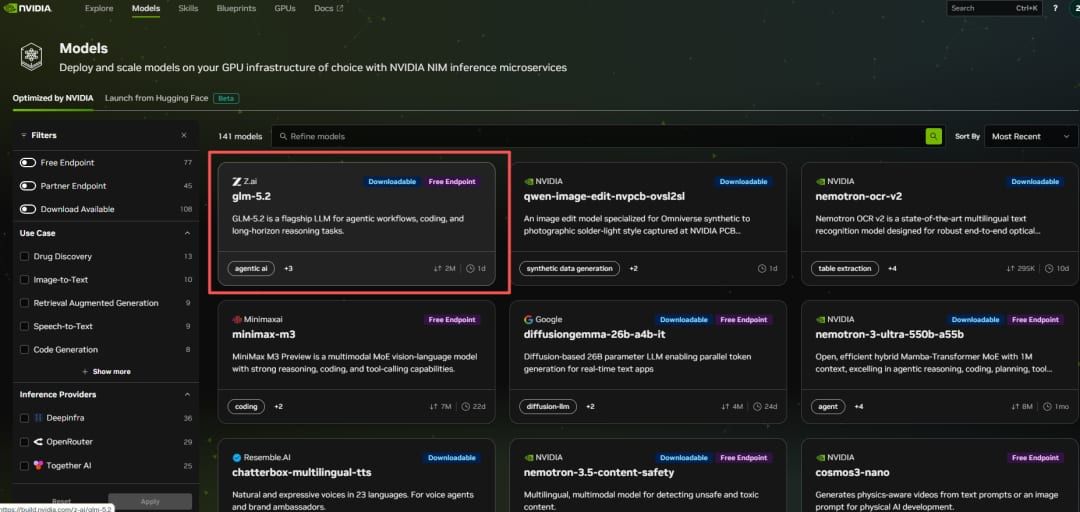
Here is the part that matters. This free API is structurally different from the two tools I covered before. CatPaw and QoderWork are finished products — install, open, click. The model is sealed inside their UI; you only ever touch it through their surface. NVIDIA hands you a raw API endpoint. It speaks the OpenAI format. Anything that accepts that format can call it.
Anything. Including Claude Code.
If the word "API" makes your eyes glaze over, keep reading. There is a graphical tool called CC Switch that does the configuration in about four clicks.
🧬 Three Parameters: base_url, api_key, model
First, the technical floor. Open the GLM-5.2 page on NVIDIA's platform and it lists three values:
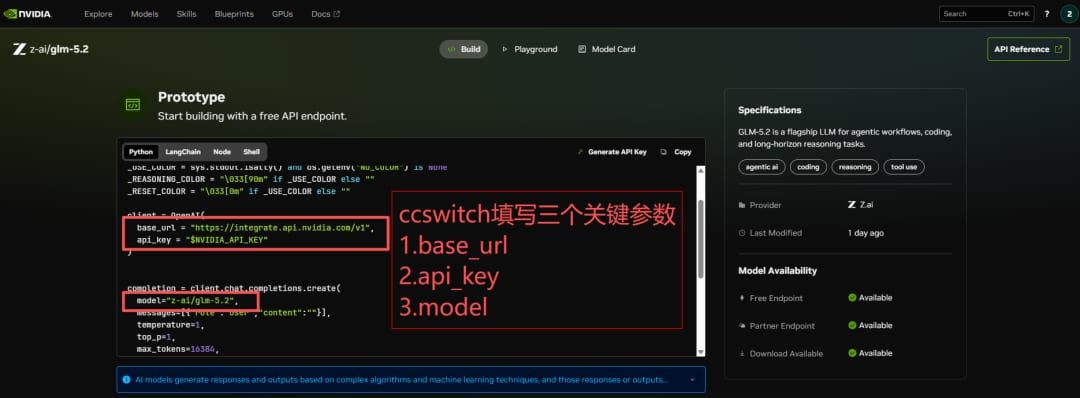
- base_url:
https://integrate.api.nvidia.com/v1(in practice the trailing/v1turns out to be optional) - api_key: the
nvapi--prefixed secret you generate in the next step - model:
z-ai/glm-5.2
If you write code for a living, you are done here — grab those three values and call the OpenAI-compatible endpoint. Python, Node, and Shell samples are right there on the model page. But most readers do not want to wrestle a CLI. What NVIDIA is handing you is an ingredient, not a dish. Once you have the key, you can plug it into Claude Code, Cursor, half a dozen VS Code AI plugins, or anything you have written yourself. You pick the tool. The model is free. How you combine them is your call.
That is the real unlock. Next: how to grab the key, then how to point Claude Code at it.
⚖️ The Free Three & The Catch
Line the three free channels up and the gap is not subtle:
| Channel | Free quota | Limit | Form factor |
|---|---|---|---|
| CatPaw (Meituan) | 500 calls | Hit the cap and you submit a form, wait for review | Sealed inside an IDE |
| QoderWork (Alibaba) | 2,000 credits | 30-day expiry, unused credits evaporate (readers report burning through them in days) | Sealed inside a desktop app |
| NVIDIA NIM | Unlimited key | ~40 RPM, peak-hour queueing | Bare API, plugs into anything |
The contrast is right there. CatPaw's 500 calls run out, and then you are filling out a reset form and waiting on a review. QoderWork's 2,000 credits evaporate after 30 days — comment sections are full of people saying they never last the month. NVIDIA just hands you a key with no ceiling. The free-tier blurb on the page literally reads Unlimited API requests without daily limits. No daily cap.
Now the asterisk. "Unlimited" deserves an eyebrow. Free things always hide a cost somewhere, and NVIDIA's free tier has a well-known one: peak hours are slow. Not just in my experience — developer communities overseas report the same thing. When the platform is busy, requests queue or return straight 429s, and latency stretches from a few seconds into the tens of seconds. Someone on Threads put it bluntly: Peak hours, you queue up and wait. Off-peak is genuinely fine — late nights and weekends, it pulls hard. But if you are banking on it absorbing heavy traffic on a Tuesday afternoon, you will get burned.
One more thing, said plainly: GLM-5.2 is not Claude. It does not have Claude's system prompting, Claude's conversational personality, or Claude's stability on long, multi-step reasoning. Once you wire it into Claude Code through CC Switch, the interface looks identical — but the flavor of the answers is different. Some tasks it handles better than you would expect, some worse. Which is which is something you can only learn by running it on your own real projects. Nobody else's benchmark substitutes for your own feel.
🛠️ Get a Key in Five Minutes + Wire It Into Claude Code
Step one: a key in five minutes
Open build.nvidia.com and sign up. Got a Google or GitHub account? Use it — single sign-on, no separate registration. Once you are in, you have to verify a phone number before you can mint an API key. Here is the part most people get wrong: mainland Chinese numbers work. Pick China from the Location dropdown, type your +86 number, hit Send Code to Phone, and a six-digit code lands on the handset.
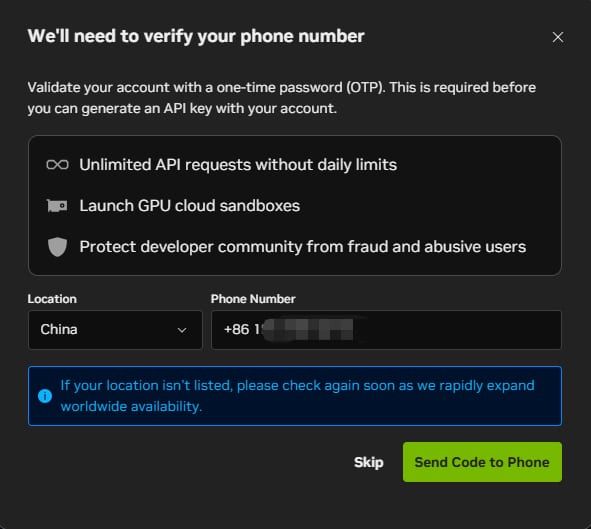
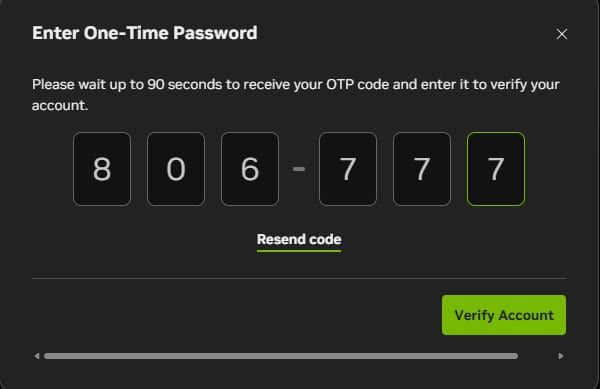
I tested it myself — the SMS landed in seconds.
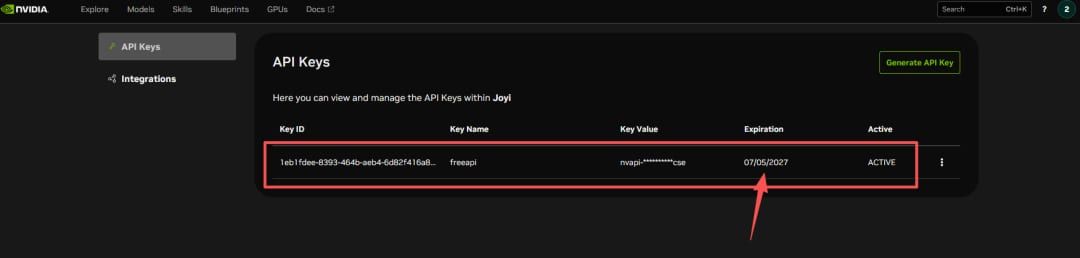
Phone verified, head up to the top-right account menu, open API Keys, and click Generate API Key. Name it whatever you like — say, freeapi. The platform spits out a string starting with nvapi-. This key is shown exactly once. Close the page and it is gone forever — copy it immediately.
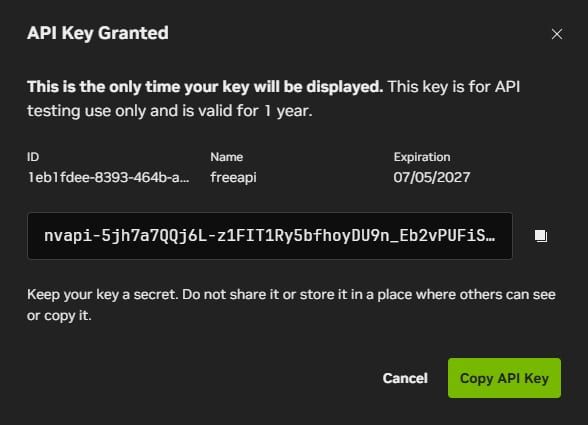
Check the expiry date: July 5, 2027. I set that key to live for a year. There is also a "never expires" option — but there is no telling when NVIDIA pulls the plug on this whole giveaway, so a one-year cap is the safer bet. The endpoint itself runs on NVIDIA's global infrastructure. No region lock, no VPN, no Chinese payment rail — a developer anywhere, Japan included, can register with an email and start calling.
Step two: point Claude Code at it with CC Switch
You have the key. Now the real question: how do you actually use it.
If you write code, take the three parameters from the previous section and call the OpenAI-compatible endpoint yourself. Everyone else — meet CC Switch. It is a graphical model-provider manager built specifically for swapping the model underneath Claude Code. Open it and you are staring at a dense list of providers: SiliconFlow, OpenRouter, GitHub Copilot, Codex, dozens of them. NVIDIA is one of them. Click the blue Nvidia button and it pre-fills the request URL for you — all you do is paste your key.
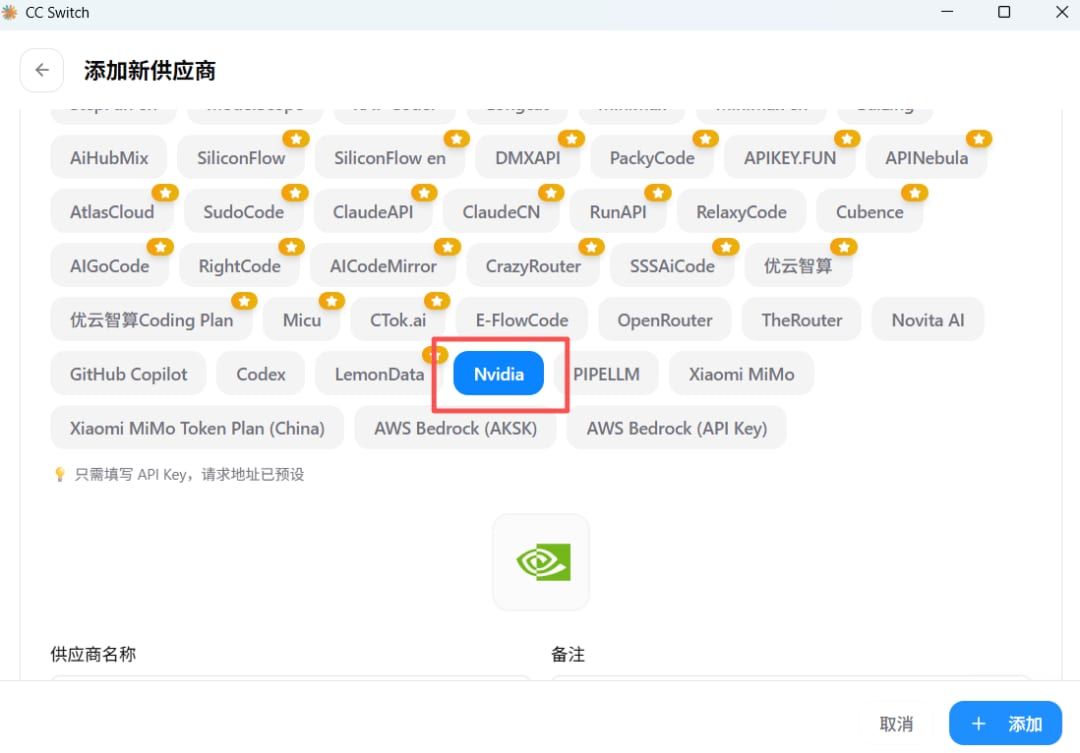
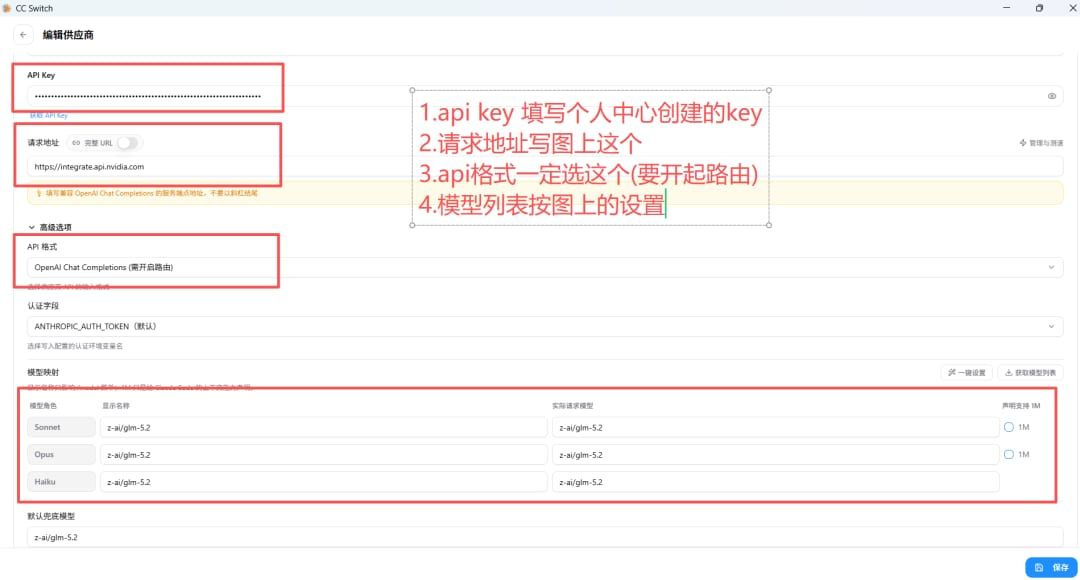
Four things to get right:
- API Key: your
nvapi-secret. - Request URL:
https://integrate.api.nvidia.com— already pre-filled by CC Switch. - API format: must be OpenAI Chat Completions (with routing enabled). Pick anything else and the request shape will not match.
- Model mapping — the critical one: map Sonnet, Opus, and Haiku all to
z-ai/glm-5.2. Now every role Claude Code can invoke actually runs GLM-5.2 under the hood.
Save, open Claude Code, type /model. Where the list used to say Sonnet 4.6 and Opus, it now reads z-ai/glm-5.2. Select Custom Sonnet model, send it a "hi" to test.
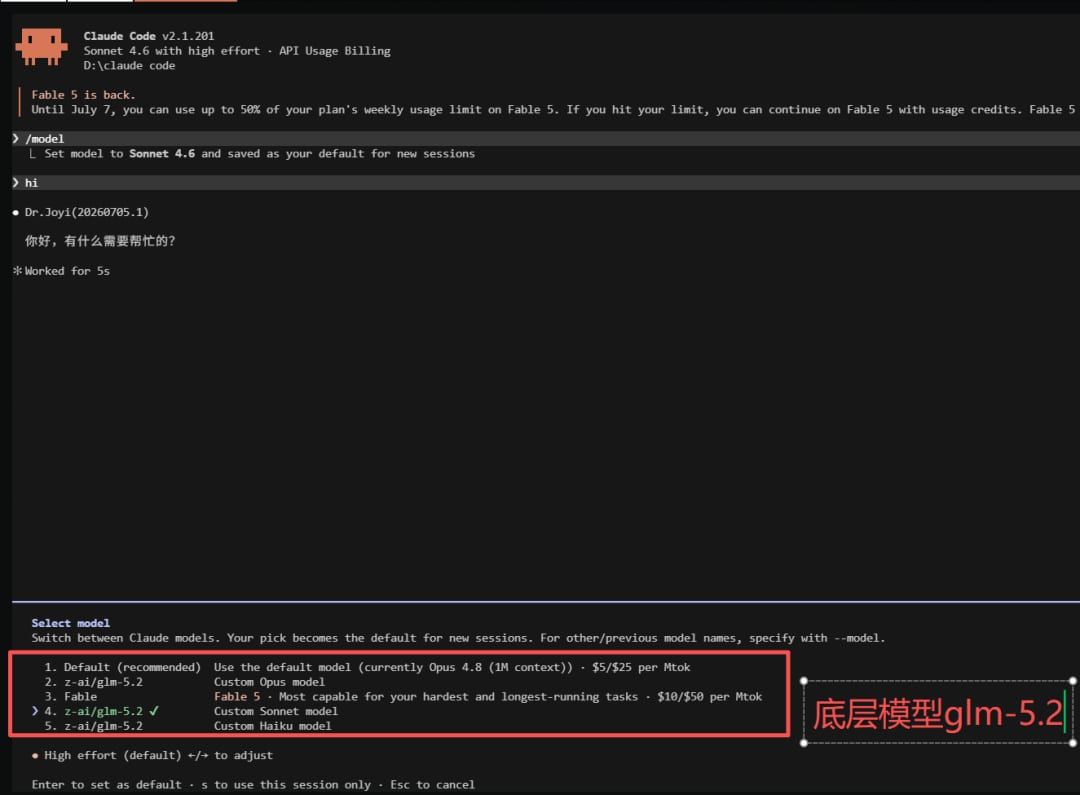
It works.
What you now have is Claude Code's full UI and agent workflow — multi-file editing, autonomous execution, context management, tool calling — all intact, with GLM-5.2 swapped in as the inference engine. Nobody looking over your shoulder could tell from the surface. The terminal still shows the Claude Code logo, the same interactions, the same /model command. But every request is hitting NVIDIA's GPU cluster, and the model answering is Zhipu's GLM-5.2.
Claude Code, used normally, costs the Max plan at $100 a month — or pay-as-you-go through API Usage Billing. With NVIDIA's free endpoint plus CC Switch, same interface, same workflow, the underlying model bill is zero. For anyone who wants to live inside the Claude Code workflow without the Claude Code budget, this is a genuinely practical substitute.
🌍 The Business Behind "Free": Three Layers, One Model
Three posts in, I am no longer just talking about GLM-5.2 the model. Line the three pieces up and a clean stack emerges:
- Layer one — application. Meituan and Alibaba. They stuff GLM-5.2 into their own products (CatPaw the IDE, QoderWork the desktop sidekick) and use a free model to herd end users. Whether it is any good depends mostly on the wrapper.
- Layer two — infrastructure. NVIDIA. It puts GLM-5.2 on its own GPU cloud and exposes a free API endpoint, using free compute to rope in developers.
- Layer three — model. Zhipu itself. It open-sources GLM-5.2 outright under MIT and lets everyone distribute it.
Three layers, three business logics, three completely different meanings of "free." The same water running under all of them.
Why is NVIDIA doing this? It is not a model company. Think about what NVIDIA actually sells — GPUs. Its H200 and B200 chips run several thousand dollars apiece. Its biggest customers are the companies that need inference compute at scale. The free API, on the surface, looks like NVIDIA subsidizing other people's models. What it is actually doing: pulling developers onto NVIDIA infrastructure to write code, test models, and build prototypes. The day your project needs production capacity, the natural next move is to buy NVIDIA GPUs — or pay for NVIDIA's inference service.
This used to be unimaginable. Models used to be closed: GPT-4 lived only on OpenAI's platform, Claude only on Anthropic's — to use a model, you entered that company's walled garden. GLM-5.2 breaks that rule. It is open source, MIT-licensed, free for anyone to pick up. So Meituan builds an IDE on it, Alibaba builds an office tool on it, NVIDIA builds a free-API funnel on it. Every one of them is using the same model to fight for its own user entry point — and none of them owns the model.
Zhipu did something smart: it does not compete with these giants for end users. It is the water source. Anyone who wants to irrigate their field can — the water is free. But if every field runs on my water, the river becomes infrastructure. To get around it, you have to dig your own well. That is the real power of an open-weights model: not the free price tag, but the fact that every competitor becomes your distribution channel. The more open you are, the more indispensable you become.
In 1911, Standard Oil was ruled a monopoly by the U.S. Supreme Court and forcibly broken into 34 independent companies. Wall Street howled, certain Rockefeller was finished. The punchline: those 34 companies grew into the giants of the oil age — Exxon, Mobil, Chevron, Amoco, each a Fortune 500 name. Because Rockefeller held the original shares in every single one of them, his personal wealth was a multiple of what it had been before the breakup.
Tearing a thing apart and giving it away is sometimes not losing control. It is becoming the infrastructure nobody can do without.
📝 Bottom Line
While the giveaway is still live, go register at build.nvidia.com. It costs nothing, takes five minutes, and CC Switch clicks through the rest of the configuration for you.
The free GLM-5.2 trilogy, recapped: Meituan works the product layer, Alibaba works the product layer, NVIDIA works the infrastructure layer — each one deeper than the last. Which layer you want is up to you.
Steps and screenshots in this post are the author's own tests, as of July 2026. Free-tier quotas, rate limits, and the lifespan of this giveaway may shift at any time — trust the build.nvidia.com page over anything here. Views are the author's.