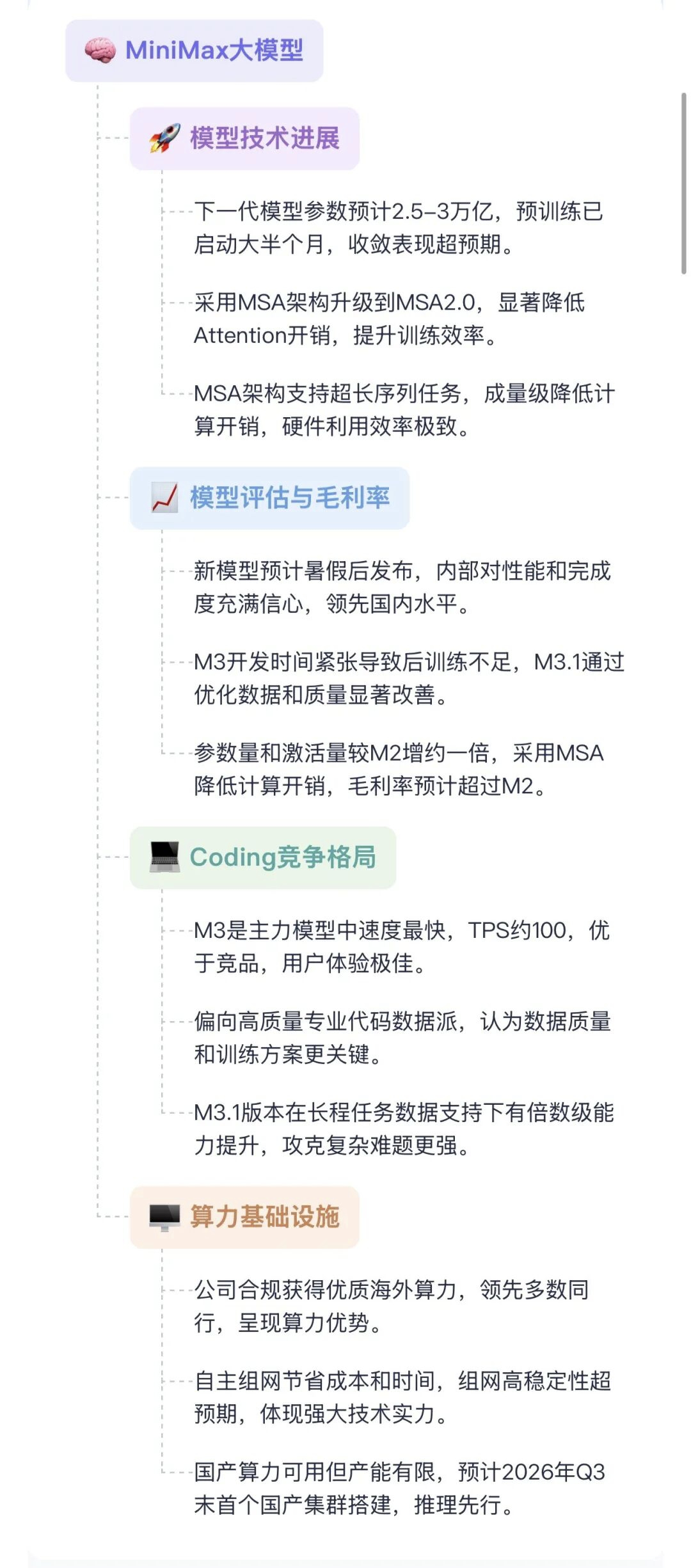
📋 The Insider Notes
A set of insider notes from MiniMax — one of China's most underrated AI labs — just surfaced. The document covers four areas: next-gen model development, competitive positioning on coding benchmarks, compute infrastructure strategy, and gross margin outlook. Taken together, they paint a picture of a company that's about to make a serious move in the frontier model race — and potentially reshape the pricing landscape for Chinese AI APIs.
MiniMax isn't a household name outside China. But inside the industry, it's known for two things: the Lightning Attention mechanism (now evolved into MSA) that makes long-context inference dramatically cheaper, and a surprisingly strong coding model (M3) that punches above its weight class. These notes suggest both advantages are about to get much bigger.
🧬 Next-Gen: 2.5–3 Trillion Parameters
The headline number: MiniMax's next-generation model targets 2.5–3 trillion parameters. For context, GPT-4 is estimated at ~1.8T, and DeepSeek V4 is believed to be in the 1–2T range. If MiniMax hits 3T, it would be among the largest dense/MoE models ever trained.
Pre-training on the new model has already been running for about half a month, and according to the notes, convergence is exceeding expectations. The model uses MSA 2.0 architecture (more on that below) and has roughly doubled both parameter count and activation count compared to the current M2 generation.
Timeline: the new model is expected to launch after summer 2026 (likely September–October). The internal team is reportedly very confident in both performance and completion level, claiming it will lead the domestic (Chinese) market.
⚡ MSA 2.0: The Cost Efficiency Secret Weapon
MSA stands for Multi-Scale Attention — MiniMax's proprietary architecture that evolved from their earlier Lightning Attention work. The key advantage: it drastically reduces Attention computation overhead while maintaining model quality.
Why this matters for pricing:
- Training efficiency: MSA 2.0 lets MiniMax train a 3T-parameter model at a fraction of what a standard Transformer would cost. Lower training cost = less capital to recoup = more room for aggressive API pricing.
- Inference efficiency: MSA supports ultra-long sequences with an order-of-magnitude reduction in compute overhead. This means MiniMax can offer 1M+ context windows at much lower marginal cost than competitors using vanilla Attention.
- Gross margin: The notes explicitly state that despite doubling parameters and activations, the gross margin on the new model is expected to exceed M2. That's only possible if MSA 2.0 delivers real per-token cost savings.
🚀 Coding Performance & Speed
The notes reveal interesting details about MiniMax's coding strategy:
- M3 is the fastest model in the main lineup — roughly 100 tokens per second (TPS), which the notes claim is faster than any competitor. For coding workflows where developers are watching output stream in real-time, this speed advantage translates directly to better UX.
- MiniMax's training philosophy leans toward high-quality professional code data over sheer volume. The notes emphasize that "data quality and training methodology matter more than quantity" — a contrarian stance in an industry obsessed with dataset scale.
- M3.1 was a major upgrade over M3 (which suffered from rushed post-training). By optimizing data quality and adding long-horizon task data, M3.1 achieved order-of-magnitude capability improvements on complex coding problems.
For the China AI Arbitrage audience: MiniMax's coding model is currently priced at ~$1.20/M output tokens — already competitive with Qwen and cheaper than GLM. If the next-gen model delivers on its promises, MiniMax could become the best coding value proposition in the Chinese AI market.
🏗️ Compute Infrastructure: The Overseas Advantage
One of the most revealing sections: MiniMax has secured compliant access to overseas GPU compute, putting it ahead of most Chinese AI competitors who are scrambling for domestic alternatives.
- Self-built networking: MiniMax built its own inter-GPU networking infrastructure instead of relying on vendor solutions. The notes claim this saved both cost and time, with stability "exceeding expectations."
- Domestic compute pipeline: Domestic (Chinese-made) GPUs are usable but capacity-limited. MiniMax expects its first domestic GPU cluster to come online in Q3 2026, starting with inference workloads.
- The dual-track strategy: Overseas GPUs for training (where you need cutting-edge performance), domestic GPUs for inference (where you need scale and cost efficiency). This is the pragmatic approach most Chinese labs aspire to — MiniMax appears to be further along in execution.
💰 What This Means for AI Pricing
Let's connect the dots on pricing implications:
| Factor | Current (M3/M3.1) | Next-Gen (3T Model) | Impact on Pricing |
|---|---|---|---|
| Parameters | ~1.5T (est.) | 2.5–3T | Higher capability ceiling |
| Architecture | MSA 1.0 | MSA 2.0 | Lower per-token compute cost |
| Gross Margin | Baseline | Expected higher than M2 | Room to cut prices or improve margins |
| Inference Speed | ~100 TPS | TBD (likely faster) | Better UX at same cost |
| Output Price | ~$1.20/M tokens | TBD | Competitive pressure on DeepSeek/Qwen |
The key takeaway: MiniMax is building a model that's both bigger AND more efficient. In a market where DeepSeek V4 Flash already offers output at $0.28/M tokens, MiniMax can't just match on price — they need to offer something different. The notes suggest their angle is: frontier-class quality + best-in-class speed + sustainable margins through architecture innovation.
🌍 The Arbitrage Angle
For China AI Arbitrage readers, here's why this matters:
Every time a Chinese lab demonstrates a more efficient architecture, it puts pressure on everyone else — DeepSeek, Qwen, GLM, Kimi — to either match the efficiency or cut prices. The race to the bottom benefits Western developers who can access these APIs at a fraction of US pricing.
Many Chinese AI labs face compute uncertainty due to US export controls. MiniMax's "compliant overseas access" means their API is less likely to face sudden capacity constraints — a real risk for labs relying solely on domestic GPUs. Stable supply = reliable arbitrage substrate.
If you're building a product that resells Chinese AI capacity to Western users, latency matters. MiniMax's 100 TPS means your end users get a snappier experience — which lets you charge a premium vs. slower alternatives. Speed is a value-add you can monetize.
⏳ Bottom Line
MiniMax isn't the loudest Chinese AI lab — that's DeepSeek. It isn't the most funded — that's Zhipu or ByteDance. But these insider notes suggest it might be the most strategically positioned: a proprietary architecture that genuinely reduces costs, overseas compute access that provides stability, and a coding model that's already competitive and getting much bigger.
Three things to watch:
- September–October 2026: The new 3T model launch. If it delivers on the "lead the domestic market" promise, MiniMax's API pricing could shift the entire competitive landscape.
- MiniMax API pricing changes: If MiniMax cuts prices after the new model launch (likely, given the improved margins), it becomes a serious alternative to DeepSeek for batch workloads.
- MSA 2.0 open-sourcing: MiniMax hasn't open-sourced MSA yet. If they do, it could dramatically lower training costs across the Chinese AI ecosystem — and accelerate the price race to zero.
The Chinese AI pricing war has a new combatant. And this one has a genuinely novel architecture to back up its moves.
Source: MiniMax insider notes (July 2026), verified against public MiniMax API pricing and benchmark data.